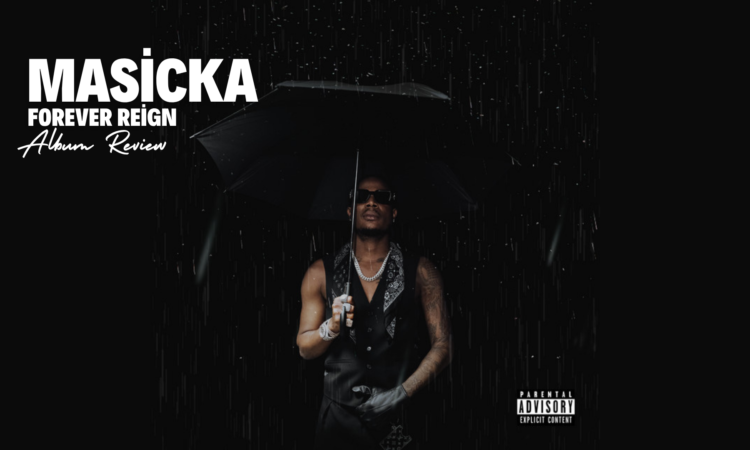
Some albums are about getting to the top. Others are about what happens when you finally get there. With Forever Reign, Masicka is no longer sounding like an artist asking for recognition, he sounds like an artist determined to make his position permanent.
Released on 14 August 2026 through Def Jam Recordings, Forever Reign is Masicka’s third studio album: a 17-track, approximately 48-minute project that follows 438 and 2023’s Generation of Kings.
Masicka has spent much of his career building an argument for why he belongs among Dancehall’s elite. 438 introduced the hunger. Generation of Kings represented the arrival. Forever Reign is about longevity the difference between reaching the throne and staying there. That makes this album less about proving Masicka can make hits and more about establishing a body of work that can survive beyond the current moment.
Perhaps the most telling decision is how the album begins.
Forever Reign doesn’t open with a chest-beating declaration of dominance. Instead, Masicka starts with “1 Psalm,” featuring Damian “Jr. Gong” Marley.
The combination of Masicka’s contemporary Dancehall voice with Damian Marley’s Reggae lineage immediately gives the project a deeper Jamaican context. More importantly, the song places faith, protection and perseverance at the front of the conversation before Masicka gets into money, women, status, violence and success.
The symbolism becomes even clearer when you reach the final track, “Parables,” featuring Lila Iké.
The album begins with a Psalm and closes with Parables. Between those two spiritual bookends sits a world of ambition, temptation, wealth, survival, conflict and celebration.
That framing makes Forever Reign feel deliberately constructed rather than simply assembled from a collection of songs.
Masicka Has Found His Comfort Zone, and That’s Not a Bad Thing.
One of the album’s greatest strengths is that Masicka isn’t desperately trying to reinvent himself.
He knows what works.
The wicked delivery, melodic hooks, sharp phrasing and ability to move between street narratives and vulnerability remain central to his sound. But there is a noticeable difference in the confidence behind the performance.
Earlier Masicka often sounded like a man with something to prove.
On Forever Reign, he sounds like a man who believes the evidence is already there.
That confidence allows him to move comfortably between different sides of contemporary Dancehall music. There is the aggressive Masicka on songs such as “Shakazulu” and “AK Fire”, the more reflective voice on “Breaking Chains”, and the commercially minded artist heard across tracks such as “Spend,” “Good” and “Boasty.”
The versatility isn’t simply about changing beats. It’s about changing perspective.
Masicka can sound threatening, ambitious, romantic, reflective and celebratory without losing his identity.
That’s a difficult balance to achieve.
The production throughout Forever Reign is modern, polished and unmistakably built for contemporary Dancehall, but it doesn’t completely abandon the genre’s foundations.
Bass remains important. Percussion cuts through cleanly. Melodic elements give Masicka space to work his vocal patterns, while the production frequently allows his voice to remain the focal point rather than burying it underneath unnecessary layers.
Mario “Dunw3ll” Dunwell is particularly important to the album’s sonic identity, receiving production credits on 10 of the 17 tracks. Masicka also takes production credits on several songs, further demonstrating his growing involvement beyond simply being the voice in front of the microphone.
The result is a project that sounds contemporary without completely losing the Jamaican musical DNA underneath it.
Dancehall has always evolved by absorbing new sounds rather than standing still. The challenge for today’s artists is to embrace global production without allowing Dancehall to become merely a Jamaican accent placed over international beats.
“Honor Roll” Shows the Bigger Picture
One of the album’s most interesting moments comes with “Honor Roll,” featuring Kraff Gad.
Kraff represents a younger generation of Dancehall, and Masicka giving him space is significant. The collaboration doesn’t feel like an established artist bringing in a younger name simply to tick a box.
Masicka was once the hungry artist trying to establish himself. Now he’s in the position to recognise artists coming through.
That gives Forever Reign another layer.
The album isn’t only about Masicka’s relationship with the artists who came before him. It is also about his position within the generation coming after him.
Then there is “G Wagon,” featuring Nigerian artist Blaqbonez, which broadens the album’s international perspective. The collaboration makes sense in an era when African and Caribbean music continue to influence one another and the relationship between Dancehall, Afrobeats and the wider global Black music landscape becomes increasingly important.
Rather than making the collaboration feel like an obligatory international crossover, it adds another dimension to Masicka’s world.
The Jamaican artist is clearly thinking beyond the traditional boundaries of the island while still keeping Dancehall at the centre of his identity.
There are several moments that help define Forever Reign.
“1 Psalm” establishes the spiritual foundation and immediately gives the album weight.
“Oak Tree” taps into Masicka’s more melodic and reflective side, while “Shakazulu” brings the harder Dancehall energy that longtime listeners expect.
“Honor Roll” is important culturally because of its connection between generations.
“Cross The Waters” speaks to the ambition and journey that have become central to Masicka’s story.
“Breaking Chains” is another important moment because it allows the artist to move beyond the usual Dancehall bravado and explore struggle and personal growth.
And then there is “Parables.”
With Lila Iké, Masicka ends the album in a completely different emotional space from where many of the project’s more aggressive moments began.
At 17 tracks, Forever Reign could easily have become bloated.
It doesn’t completely avoid that danger, but the sequencing gives the project enough movement to remain engaging. The first half leans heavily into the confidence, lifestyle and competitive nature of Masicka’s world before the album gradually allows more introspection to enter the conversation.
The closing stretch particularly “It’s Not Too Late,” “Time and Place,” “Breaking Chains” and “Parables,” feels more reflective than the earlier material.
That gives the album an arc.
It starts with faith, moves through ambition and material success, confronts danger and pressure, and eventually arrives at reflection.
This is where the album becomes particularly interesting.
Dancehall has always been obsessed with the idea of the crown.
From the sound-system clashes and lyrical battles of earlier generations to today’s streaming charts and global collaborations, Jamaican artists have constantly competed for position.
But the crown has changed.
Today, being a Dancehall heavyweight isn’t simply about having the biggest song in Jamaica. It is about international reach, catalogue strength, cultural relevance, streaming numbers, live performances and the ability to remain relevant when the musical landscape changes.
Masicka understands that.
His Def Jam association, international collaborations and increasingly polished albums place him in a different commercial environment from where he started.
But Forever Reign doesn’t abandon the Dancehall foundation that built him.
That’s arguably the album’s biggest achievement.
He is attempting to move forward without disconnecting himself from where he came from.
So, Is It a Great Dancehall Album?
Yes, but its greatness isn’t necessarily found in one earth-shattering song.
It’s found in the bigger picture.
Forever Reign feels like the work of an artist entering a more mature stage of his career. Masicka isn’t simply chasing the next big record. He’s thinking about his catalogue, his position and ultimately his legacy.
The album doesn’t reinvent Dancehall, nor does it need to.
Instead, it takes the ingredients Masicka has spent years developing, melodic, songwriting, streetwise lyricism, vulnerability, ambition and an unmistakable vocal identity—and puts them into a more complete package.
In a Dancehall era where singles can dominate today and disappear tomorrow, Masicka is making a case for something bigger: the importance of building an album that tells the story of where an artist is, where he has been, and where he intends to remain.
Masicka isn’t asking for permission for the crown, he’s taking it and building his own kingdom.
Forever Reign is a confident, well-produced and culturally aware statement from an artist who appears increasingly comfortable with his position. It may not reinvent Dancehall, but it reinforces why Masicka remains one of the genre’s most compelling contemporary voices—and, more importantly, suggests that his ambitions extend far beyond the next hit.