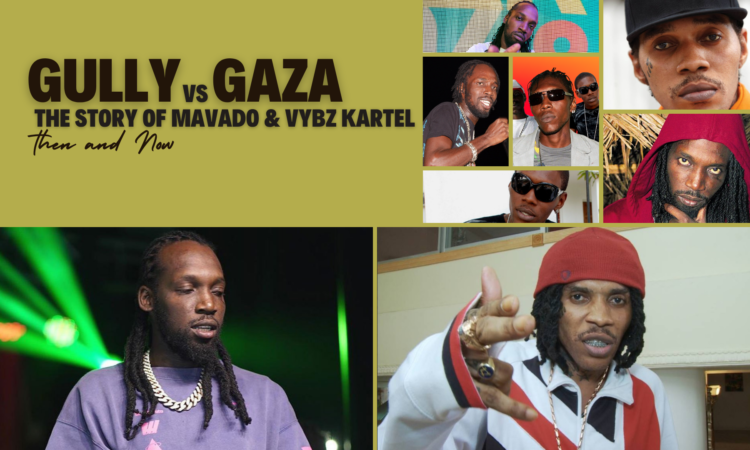
Who would have thought that after all the history, the clashes, the division and the years of silence, Vybz Kartel and Mavado would one day stand on the same stage not as rivals, but as two of Dancehall’s biggest stars giving the people what they came for?
There are certain chapters in Dancehall history that are so deeply embedded in the culture that they become bigger than the artists themselves. The names, the songs, the lyrics, the clashes and the alliances become part of the soundtrack of an era.
The story of Vybz Kartel and Mavado is one of those chapters.
Their journey is not simply a story about two successful Dancehall artists. It is a story about friendship, competition, division, influence, loyalty, musical identity and, ultimately, time. And perhaps the most remarkable part of the story is where they are today.
After years of being associated with opposing sides of one of Dancehall’s most famous cultural divisions, Gaza and Gully, the two men can now share a stage in an entirely different atmosphere.
No war.
No lyrical confrontation.
No sides.
Just music.
Before Gaza and Gully, There Was Respect
It is easy for younger listeners and fans who discovered Dancehall through the Gaza versus Gully era to forget that Vybz Kartel and Mavado were not always presented as two figures standing on opposite sides of the culture. There was a time when they were part of the same musical environment. They were young, ambitious artists navigating a competitive Jamaican Dancehall scene where reputation could change overnight and where a strong song could make or break an artist.
Both understood the language of Dancehall.
Both understood the importance of lyrics.
Both understood the streets.
And both possessed something that cannot simply be taught: star quality.
Vybz Kartel had an extraordinary ability to turn everyday Jamaican language, observations and experiences into memorable lines. Mavado brought a different kind of emotional weight, with a voice that could sound vulnerable one moment and threatening the next. They were different artists, but that difference was part of what made their eventual rivalry so compelling. At the beginning, however, there was something else connecting them: respect.
Then Dancehall Changed
The mid-to-late 2000s represented a defining period for modern Dancehall.
The music was changing. The internet was beginning to transform how music travelled. YouTube and social media would eventually make Jamaican music more accessible to an international audience, while mixtapes, sound systems, radio and street-level promotion continued to drive the culture. And in the middle of all of this emerged two personalities who would become impossible to ignore.
Vybz Kartel.
Mavado.
What started as competition gradually became something much larger.
The relationship deteriorated, and Dancehall found itself watching two of its most important young stars move in opposite directions.
Then came the names that would define an era.
Gaza.
Gully.
These were no longer simply affiliations. They became identities.
Gaza vs Gully
The rivalry between Gaza and Gully was about much more than two artists. It represented two musical camps, two fan bases and two contrasting personalities at the centre of Jamaican popular culture. On one side was Vybz Kartel and the Gaza camp. On the other was Mavado and the Gullyside camp.
Fans chose sides.
Songs became ammunition.
Lyrics were analysed.
Every release could be interpreted as a statement.
Every performance could become a moment.
The rivalry created an extraordinary amount of music, but it also created tension that extended beyond the records.
For Dancehall fans, it was appointment listening.
You wanted to hear what Kartel would say next.
Then you wanted to hear Mavado’s response.
And then Kartel again.
This was the essence of Dancehall’s competitive spirit taken to another level.
But competition has consequences.
When the Music Stops Being Just Music
One of the most fascinating things about Dancehall is the way music can blur the line between performance and real life.
A lyrical clash can begin on a record, but when artists and their supporters become emotionally invested, the consequences can move beyond the music.
That is what made the Gaza vs Gully period so significant.
The division became part of the wider culture.
People identified themselves with one side or the other.
For many fans, choosing Gaza or Gully was almost like choosing a football team.
And in the middle of it all were Kartel and Mavado.
Two artists who had once occupied the same musical space were now associated with opposing columns of Dancehall.
The irony was impossible to miss.
Both were helping to push Jamaican music forward.
Both were becoming international stars.
Both were creating music that would outlive the moment.
Yet they were not standing together.
For years, there was no real relationship between them.
They clashed.
They exchanged lyrical shots.
And eventually, the silence became just as significant as the music.
Time Has a Way of Changing Perspective
This is where the story becomes particularly interesting.
Dancehall is a young person’s culture, but its greatest artists eventually reach a point where they have lived through enough history to see things differently.
The things that seemed enormous at 25 can look very different at 40.
The battles that once felt like they could never end eventually become chapters in a much larger story. Both Mavado and Vybz Kartel have travelled extraordinary paths since the height of the Gaza vs Gully conflict.
They have experienced international success.
They have built catalogues.
They have influenced generations of artists.
They have watched Dancehall evolve.
And perhaps most importantly, they have watched the generation that grew up with Gaza and Gully become adults. The fans who once argued over which side was superior are now older.
Some are parents.
Some are artists themselves.
Some are the very people buying tickets to see both men on the same stage.
That is the power of time.
Vybz Kartel: The Artist Who Never Left the Conversation
Few artists in Dancehall history have maintained the level of cultural relevance that Vybz Kartel has.
His influence stretches far beyond the traditional definition of a successful recording artist.
His vocabulary, songwriting, melodies, rhythms and approach to Dancehall have influenced countless artists.
Even during his years away from the physical stage, Kartel remained present in Dancehall.
His music continued circulating.
His lyrics continued being quoted.
His songs continued appearing in clubs, parties, sound systems and playlists around the world.
His return to the stage therefore represented more than a concert appearance.
It was a cultural moment.
And now, seeing him share that stage with Mavado carries another layer of significance.
Mavado: The Gully Singer Who Became an International Voice
Mavado’s journey has been equally remarkable.
From the streets of Kingston to international stages, he developed a sound that was unmistakably his own.
His voice became one of the defining sounds of modern Dancehall.
There was always an emotional quality to Mavado’s music, whether he was singing about struggle, relationships, ambition, violence, survival or life in Jamaica. That emotional range helped him move beyond the boundaries of the Gully movement.
Mavado became an international Dancehall artist.
And just like Kartel, his music survived the era that created the rivalry.
The Gully became a chapter.
Mavado became the artist.
And Then Came the Plot Twist Nobody Expected
Which brings us to the moment that would have seemed almost impossible during the height of the rivalry.
Gaza vs Gully on the same stage.
But this time, the title means something different.
There is no need for the artists to prove who is better through conflict.
There is no need for lyrical warfare.
The audience already knows the history.
Instead, the history becomes part of the entertainment.
The very thing that once divided fans can now bring them together.
Mavado performs his catalogue.
Kartel performs his.
The audience sings every word.
And suddenly, the old rivalry becomes a celebration of Dancehall history.
That is a powerful transformation.
The Audience Has Changed Too
Perhaps the most important character in this story is not Kartel or Mavado.
It is the audience.
The people who experienced Gaza vs Gully when it was happening are now looking at the story from a completely different perspective.
They remember where they were when certain songs dropped.
They remember the arguments.
They remember the sound clashes.
They remember choosing a side.
They remember the excitement.
And now they have the opportunity to experience both artists together.
There is something beautiful about that.
The audience doesn’t need them to fight anymore.
They simply want to hear the music.
That is maturity.
Not just from the artists, but from the culture itself.
From Division to Celebration
The phrase Gaza vs Gully once represented division.
Today, it can represent celebration.
That is the irony.
The same two names that once encouraged fans to stand on opposite sides can now appear on the same concert poster.
The same artists who once exchanged lyrical shots can now perform for the same audience.
The same songs that were once viewed through the lens of rivalry can now simply be appreciated as great Dancehall records.
And perhaps that is how it should be.
Because when history is written, the rivalry will always be part of their story.
But it does not have to be the ending.
Two Columns of Dancehall History
Vybz Kartel and Mavado ultimately became much bigger than Gaza and Gully.
They became two columns of modern Dancehall.
Their influence can be heard in the artists who came after them.
Their songs remain part of the culture.
Their names remain recognisable far beyond Jamaica.
And their rivalry, whether people loved it or hated it, helped create one of the most talked-about periods in Dancehall history.
But there is another lesson here.
Artists grow.
People change.
Circumstances change.
And sometimes, after years of separation, two people can stand in the same place again without needing to recreate the conflict that once existed between them.
Who Would Have Thought?
If someone had told Dancehall fans during the height of Gaza vs Gully that one day Vybz Kartel and Mavado would be sharing a stage, performing their biggest songs while the audience celebrated both of them, many would probably have laughed.
It would have sounded unrealistic.
Almost impossible.
Yet here we are.
After the clashes.
After the division.
After the years of silence.
Gaza and Gully can now stand together.
Not to fight.
Not to prove who is better.
But to entertain.
And perhaps that is the biggest victory of all.
Because Dancehall has always been about evolution.
Today’s rivalry becomes tomorrow’s history.
Today’s enemy can become tomorrow’s collaborator, performer or simply someone you can share a stage with.
Vybz Kartel and Mavado don’t need to erase their history.
That history is part of what made them who they are.
Instead, they can stand on that history, acknowledge how far they have both travelled and give the people something they never thought they would see:
Gaza and Gully together on one stage.
After everything that happened, who really would have thought?