If you really want to understand Dancehall, look beyond the music and look at what the artists wore around their necks, wrists and fingers. Jewellery was never simply decoration; it was part of the statement. A heavy chain could announce that you had arrived, a ring could speak to status, and a pair of earrings could become just as recognisable as the artist wearing them.
Long before Instagram, TikTok and social media turned fashion into instant content, Dancehall artists already understood that image carried power. The clothes told a story, the shoes made a statement, the hairstyle created an identity, but jewellery had a language of its own and for decades, Dancehall has been speaking it loud.
You could see a deejay coming before you heard him speak. A thick gold chain hanging across the chest, rings catching the light, a bracelet moving as he gestured to the crowd, these things became part of the character. They helped create the presence. And when you look back across the history of Dancehall, you can see that the jewellery changed as the music evolved.
The big rope chains of the 1980s and 1990s eventually gave way to diamonds, custom pendants and fully iced-out pieces. But although the style changed, the message remained remarkably similar.
I have arrived.
WHEN GOLD WAS KING
Take yourself back to the Dancehall of the 1980s and 1990s. Gold was everywhere. Not the kind of jewellery you barely notice. I’m talking about heavy rope chains, rings, bracelets, medallions and multiple pieces worn together. Jewellery had presence. It was supposed to be seen. And artists such as Shabba Ranks, Ninjaman, Johnny P and Sanchez understood that the Dancehall performer was more than a voice on a record.
You had to look the part.
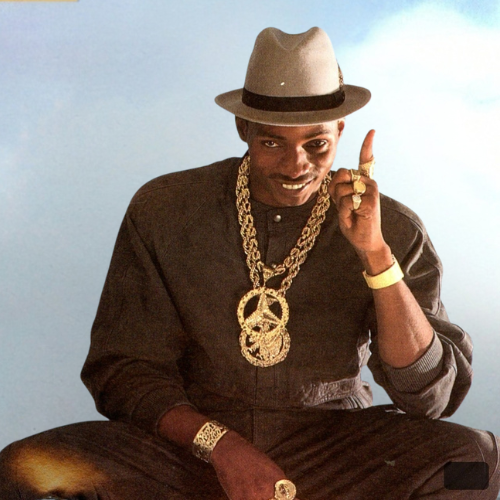
Ninjaman is a perfect example. There was always something theatrical about the way he presented himself. The clothes, the jewellery, the movement, the energy and the way he commanded a stage all came together. You didn’t just watch Ninjaman perform; you watched a character walk into the dance.
Shabba Ranks took that idea to another level internationally. His gold jewellery became so closely associated with his image that, years later, American Hip-Hop artists were still referencing the Shabba look.
Then there was Johnny P.
His rings and jewellery were not some small detail tucked away in the background. They were part of his appearance. Johnny P himself spoke about the amount of jewellery he wore and the enormous chains and rings associated with that period. When you put all of that together, you begin to understand something important. Jewellery wasn’t simply following Dancehall fashion.
Dancehall was helping to shape fashion.
THE ROPE CHAIN HAD A PRESENCE OF ITS OWN
There was something special about the old rope chain. Maybe it was the weight of it. Maybe it was the way it moved. Or perhaps it was simply because you knew what it represented. When a deejay moved across the stage, the chain moved with him. When the lights hit it, it caught your eye. When the artist leaned towards the crowd, you saw it.
It almost became part of the performance.
That makes sense when you remember where Dancehall came from. This wasn’t music designed to be consumed quietly. It came alive at dances, in yards, at sound-system sessions, in clashes, at stage shows and in packed venues where the audience was close enough to see the artist from head to toe.
The artist had to have presence.
You couldn’t simply sound like somebody.
You had to look like somebody too.
For many young Jamaican men watching these artists, that gold chain represented more than wealth. It represented achievement. It represented the possibility of moving from one position in life to another.
You could look at a successful deejay and think, One day, that could be me. That is where the emotional side of the jewellery story comes in. The chain was often a symbol of the journey.
SHABBA RANKS AND THE GLOBAL IMAGE OF DANCEHALL
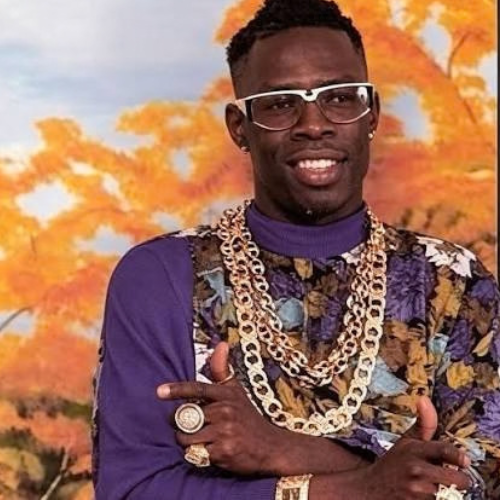
Shabba Ranks is particularly important when discussing this because his image travelled far beyond Jamaica.
By the time Shabba became an international star, the gold chains, rings, clothes and overall appearance had become part of what people outside Jamaica associated with Dancehall. Years later, A$AP Ferg would even use Shabba’s name as the title of a Hip-Hop record. That tells you something.
The influence wasn’t limited to the music.
The look travelled too.
And that is something Dancehall doesn’t always get enough credit for.
Jamaica has influenced the world musically, but Jamaican culture has also influenced how artists in other genres dress, perform and present themselves.
The sound system influenced Hip-Hop.
The deejay influenced the MC.
And the visual language travelled alongside it.
NINJAMAN: WHEN THE DEEJAY BECAME A CHARACTER
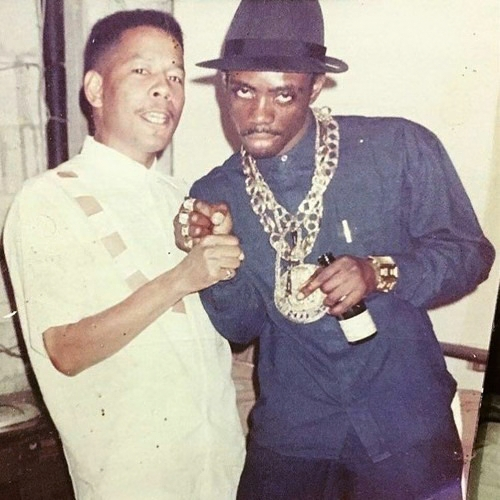
With Ninjaman, jewellery was part of a much bigger picture. He understood the theatre of Dancehall. Everything had to work together. The clothes. The hat. The jewellery. The movement. The lyrics. The voice. The attitude.
There was no separation between the performer and the character. That is one of the things many people miss about some of the older Dancehall eras. Artists developed an identity that you could recognise almost immediately.
You didn’t need a logo on the screen telling you who you were watching. Sometimes the jewellery, clothing and overall appearance told you everything.
The street was the runway.
The dance was the fashion show.
The sound system was the stage.
And the deejay was the centre of it all.
JOHNNY P AND THE BEAUTY OF EXCESS

Johnny P is another artist who reminds us that Dancehall has never been afraid of excess. His rings were part of his signature appearance. He was not trying to make jewellery disappear into the outfit. Quite the opposite. It was meant to be noticed. And that fits Dancehall perfectly because exaggeration has always been part of the culture.
The sound systems were loud.
The personalities were big.
The lyrics could be outrageous.
The performances were energetic.
The fashion could be extravagant.
So why wouldn’t the jewellery follow the same direction?
Dancehall has never been afraid of saying:
If we’re going to do it, we’re going to do it properly.
THEN THE JEWELLERY STARTED TO CHANGE
As Dancehall moved through the 1990s and into the new millennium, something began to shift. Gold didn’t disappear. Far from it. But diamonds began taking up more space. Custom pendants became more important. Platinum became part of the conversation. Iced-out pieces started appearing more frequently.
And the difference wasn’t simply that the jewellery became more expensive. It became more personal. Artists could have their names made into pendants. They could wear symbols connected to their crew, their brand, their neighbourhood or their music.
The jewellery could now tell you exactly who the artist was. That was a major change.
The chain wasn’t just saying, Look how much money I have.
It could also say:
This is my identity.
VYBZ KARTEL AND THE NEW LANGUAGE OF JEWELLERY
Vybz Kartel is one of the artists who really represents that transition into the modern era. Kartel understood the importance of branding in a way that went beyond music. The tattoos, colours, clothing, phrases, artwork and jewellery all became part of the same visual world. That is why his jewellery is interesting.
It wasn’t necessarily about putting on the biggest piece simply because it was expensive. It was about creating an image people could recognise. That is the point where jewellery starts moving from an accessory into branding.
And once that happened, the possibilities became much bigger.
FROM GOLD TO ICE
The old generation often made its statement through the sheer size and weight of the gold.
The new generation has increasingly made that statement through diamonds.
Gold has warmth.
It has weight.
It has that unmistakable colour that catches your eye immediately.
Diamonds do something different.
They flash.
They sparkle.
They react to light.
And that makes them particularly suited to the modern Dancehall environment. Think about how music videos are shot now. Think about social media, phone cameras, Instagram, TikTok and high-definition photography. A piece of iced-out jewellery can almost become part of the visual effect.
The artist moves.
The lights hit the stones.
The chain flashes.
The camera catches it.
And suddenly that piece becomes part of the image people remember.
The jewellery isn’t only being worn anymore.
It’s being photographed, filmed, posted, shared and turned into part of the artist’s identity.
VALIANT AND THE JAMAICA MAP
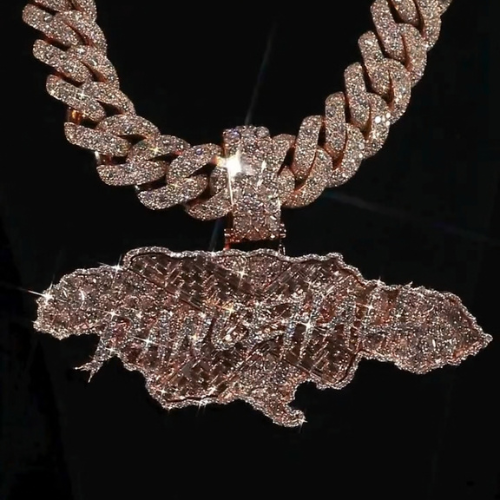
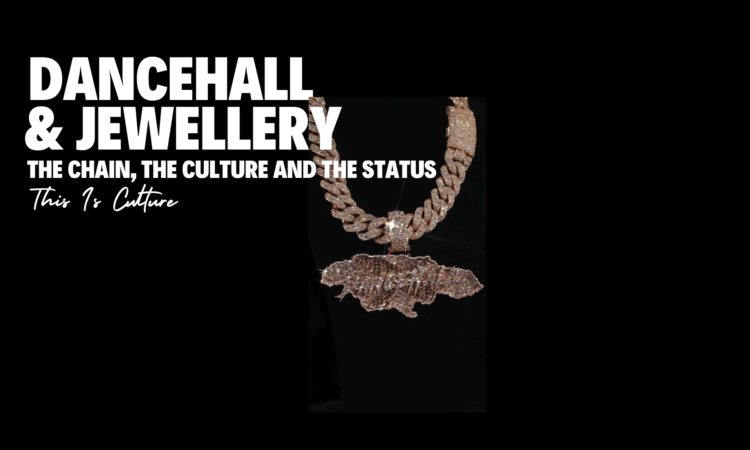
This is where Valiant’s recent jewellery choice becomes particularly interesting. An iced-out chain shaped like the map of Jamaica, with Dancehall written across it, this piece is saying something very different from simply wearing an expensive diamond chain.
It connects the jewellery directly to Jamaica and the culture that produced the artist. You can look at that piece as luxury, but you can also read it as representation.
The map is Jamaica.
The word Dancehall connects it to the music.
Put the two together and the piece becomes almost like a small piece of Jamaican cultural identity being worn around the artist’s neck.
That is a powerful idea. The message doesn’t have to be complicated.
It can simply say:
This is where I come from.
This is my culture.
This is the music that made me.
And that is where modern Dancehall jewellery becomes much more interesting than simply counting carats.
MASICKA, BUSY SIGNAL, KONSHENS AND A NEW GENERATION
You can see the same evolution in artists such as Masicka, Busy Signal and Konshens. Each artist has his own presentation, but the modern Dancehall jewellery aesthetic is clearly there. Busy Signal is particularly interesting because he has always been able to move between generations.
He can carry elements of the older Dancehall look while still presenting himself in a modern way. That is one of the great things about Jamaican culture. It doesn’t always throw away the old. Sometimes it’s taken, reshape and costumed for the next generation. The rope chain didn’t disappear.
It evolved.
Gold didn’t disappear.
It was joined by diamonds.
And the traditional pendant eventually became something much more customised.
THE CHAIN BECAME A BUSINESS CARD
This might be one of the biggest changes of all. Today, a piece of jewellery can become almost as recognisable as an artist’s logo. You can see a custom pendant in a photograph and immediately know who it belongs to.
That’s powerful branding. Especially now.
An artist can post a photograph on social media and within seconds it can be seen by people in Jamaica, London, New York, Toronto, Africa and everywhere else Dancehall has reached. People might not read the caption. They might not even know where the photograph was taken. But they recognise the image.
And sometimes the jewellery is part of what makes the image recognisable. The chain has become visual shorthand.
DANCEHALL, HIP-HOP AND THE EXCHANGE OF STYLE
It would be wrong to say Dancehall invented extravagant jewellery in music. Hip-Hop has an enormous jewellery history of its own. But the relationship between Jamaican music and Hip-Hop is impossible to ignore. Jamaican sound-system culture travelled to New York with Caribbean communities, and those ideas became part of the environment from which Hip-Hop developed.
The influence went both ways.
Hip-Hop took the chain and made it part of its own language.
Dancehall continued developing its own version.
Then artists from both worlds began borrowing, remixing and reinterpreting each other’s styles.
Shabba Ranks is a perfect example of that connection.
His jewellery became so recognisable that an American rapper could reference Shabba decades after the original era and expect people to understand exactly what he meant. That is cultural influence.
HOW DANCEHALL JEWELLERY INFLUENCED OTHER GENRES
This is where the conversation becomes even bigger. Dancehall’s influence on other genres isn’t only about rhythms, riddims and vocal styles.
The attitude travelled.
The fashion travelled.
The confidence travelled.
The idea that an artist could build a complete identity around music, clothing and jewellery travelled. Hip-Hop obviously became one of the biggest places where that influence could be seen. But the wider impact is much broader. Artists across Afrobeats, UK music, R&B and contemporary urban music now operate in a world where custom jewellery is part of the artist’s branding. The modern artist isn’t simply selling a song.
They’re selling an image.
A lifestyle.
A story.
A world.
And Dancehall understood that long before Instagram existed.
THE STREET TAUGHT THE LUXURY WORLD TOO
There is something else worth remembering. For years, certain styles associated with street culture were treated as separate from the luxury world. Then the luxury world began looking back at the streets. Custom chains, oversized jewellery, diamonds, personalised pendants and artist collaborations became increasingly visible in mainstream fashion.
The influence didn’t only move from luxury brands down to music. Sometimes it went the other way.
The street showed the luxury industry what people actually wanted to wear.
And Dancehall was part of that conversation.
WHY JEWELLERY MEANS SO MUCH IN DANCEHALL
This is the part that shouldn’t get lost. It is easy to look at a giant chain and simply say, That’s expensive. But there can be much more behind it.
Think about the young fan watching Shabba Ranks in his prime.
Think about the young man watching Ninjaman command a dance.
Think about somebody seeing Johnny P covered in rings.
Then imagine that same person growing up, becoming an artist and eventually being able to buy or commission his own piece. That chain means something different now. It is no longer something hanging around somebody else’s neck. It is evidence of the journey.
It says:
I made something of myself.
That emotional connection is why jewellery has remained so important.
BUT THERE IS A FLIP SIDE
There is also another side to this conversation. Dancehall has always celebrated success, but modern social media can turn that celebration into pressure. There is always another chain.
Another watch.
Another set of diamonds.
Another artist with something bigger.
And when young people see that constantly, it can create the impression that success has to be visible to be real. That is where we have to be careful. Because the most meaningful piece of jewellery isn’t necessarily the most expensive one. Sometimes it is the piece with the best story.
A Jamaica map.
A Dancehall symbol.
A name.
A family reference.
A personal achievement.
Something connected to the artist’s journey.
When jewellery carries meaning, it becomes much more powerful than simply showing wealth.
THE GOLD CHAIN HASN’T REALLY DISAPPEARED
I don’t believe the gold-chain era is dead. It has simply become part of Dancehall’s history. You can see a young artist wearing an iced-out pendant today and, at another time, see him wearing a thick Cuban link or traditional rope chain.
The generations have started to overlap.
The old style is still there.
The new style has simply added another layer. And perhaps that’s the best way to understand Dancehall fashion in general. It doesn’t always replace. It builds. New generation takes something from the old generation, changes it, adds its own personality and sends it forward. That’s how culture survives.
THE CHAIN IS PART OF THE MUSIC
After watching Dancehall change for so many years, it’s difficult to separate the jewellery from the music.
They grew together.
The riddim gives you the sound.
The voice gives you the message.
The clothes give you the appearance.
The hairstyle gives you another part of the identity.
And the jewellery adds that final flash.
From the heavy rope chains of Shabba Ranks, Ninjaman and Johnny P, through Sanchez and the polished look of that era, to Vybz Kartel’s highly branded image and the iced-out jewellery being worn today by artists such as Masicka, Busy Signal, Konshens and Valiant, the chain has remained part of the conversation.
But the meaning has changed.
Once, it was largely about gold and status. Then it became about diamonds and individuality. Now, increasingly, it can be about identity and culture.
And that Valiant Jamaica-map piece says a lot about where the jewellery conversation can go next. When you can wear the map of Jamaica around your neck and put Dancehall across it, you’re no longer simply wearing jewellery.
You’re wearing a piece of the culture.
That’s the journey I see when I look back.
From the big rope chains to the diamonds.
From gold rings to custom pendants.
From jewellery as status to jewellery as branding.
And now, increasingly, jewellery as a way of carrying Jamaica with you.
So when the lights hit that chain and the whole thing flashes for a split second, I don’t just see an expensive piece of jewellery.
I see decades of Dancehall history catching the light.